
Dr. Fidel Chacón talks about the friend who inspired his first novel, why he reads the economics hidden inside a Minions movie, and what twenty-five years in Miami taught him about belonging.
DR. FIDEL CHACÓN · ECONOMIST, AUTHOR, PROFESSOR, TRADER · MIAMI
There is a certain kind of person who refuses to be one thing. Dr. Fidel Chacón is an economist and a payments executive. He is also a university professor, a consultant, a trader and — most recently — a published novelist. He sends flowers to near-strangers, carries a monogrammed handkerchief, and considers sitting in a café doing absolutely nothing to be serious work. We met on a weekday afternoon in Brickell, the glass-and-steel heart of a city he has watched grow up around him for twenty-five years.
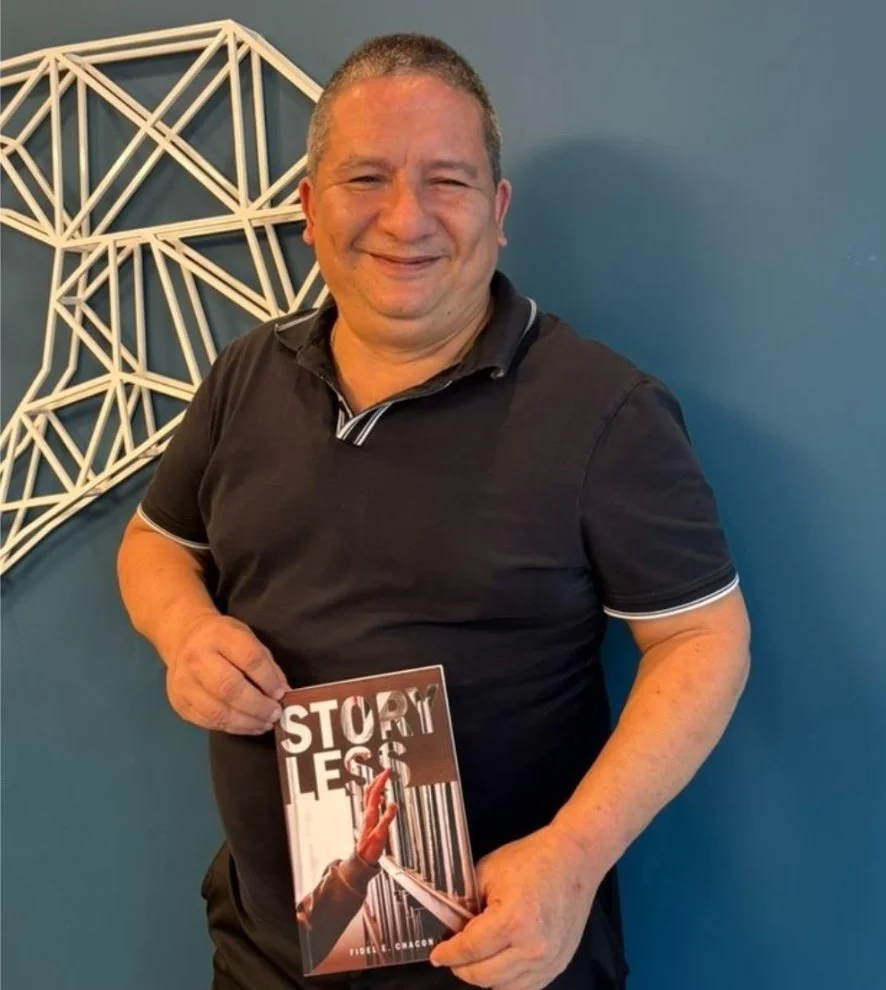
“It's a love letter to people who feel they don't belong.”
Dr. Fidel Chacón on his debut novel, Storyless.
THE FILE
ROOTS Born in the U.S. to Venezuelan parents; raised in Venezuela
HOME Miami — twenty-five years and counting
FIELD Economics & payment systems
ROLES Author, professor, consultant, trader
Who is Dr. Fidel Chacón?
My background is in economics and payments. I've stayed in the corporate world in that area, but also on the academic side — business and economics. Now I'm teaching and consulting. And in my spare time, if any, I try to write. I'm a published writer, especially fiction. Not economics — fiction. That's the summarized version of my life.
THE BOOK
Where did Storyless come from?
Several things happened at once. I had a dear friend who passed away in a car accident here in Miami in 2020. She was twenty-seven, she was from Latvia, and she had this deep love for the city. I was in a kind of transition in my own life at that time.
I started writing around 2022 as a form of self-therapy — what I was watching through the window, what happened during the day. Then I connected it with her, and the story came.
I went down the rabbit hole: what happens to the things you write? Do the stories go somewhere? That became the premise. The book is set in a fictitious world alongside Miami — a place called Backstory Town, where every story, book and piece of music ever created ends up. It's also, in part, a political satire.
“It's a love letter to people who feel they don't belong.”
When did it become a book to you?
The moment came when the story felt alive. You start thinking about your characters, their personality traits, what they're doing — and then you can step back and simply watch them, and write what they do next. That's when I knew. And that it would be a sequel. I'm working on the second one now. It's called Still Unwritten.
In retrospect, the book is a love letter to people who feel they don't belong. To an extent it's the immigrant's dilemma — do I belong to this place? The book says yes. Everybody has a place. It's just usually not the one you expected.
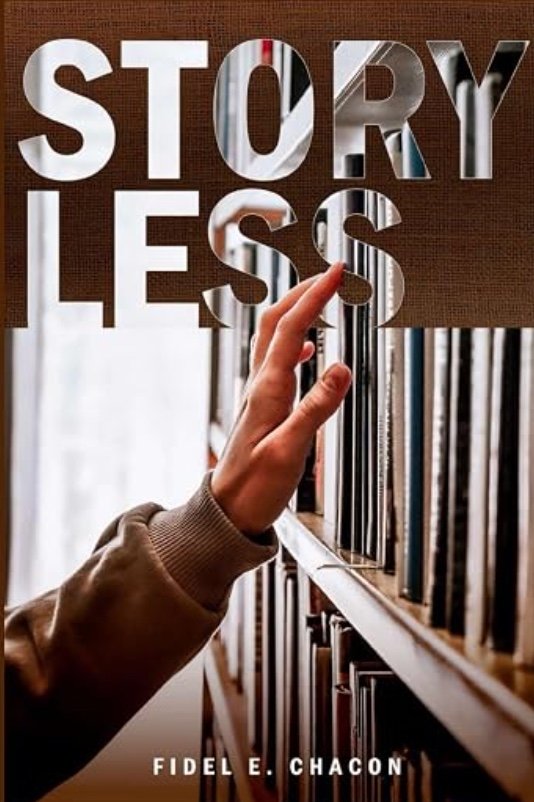
Storyless · available on Amazon
THE BOOK
Storyless follows Max, a young author, and Alena — a character born without a story of her own, and determined to find one.
Half of it unfolds in Miami; half in Backstory Town, where every story, book and song ever created ends up. Part fable, part political satire.
TWO COUNTRIES
Where did you come from?
I'm the son of Venezuelan parents. I was born in the U.S. because they were studying abroad, but I grew up in Venezuela. I moved to Miami for my education and for opportunities beyond the political and economic situation there.
I found a home here. But there's always the drama of the immigrant: here you're considered Venezuelan American; in Venezuela, maybe you're not the typical Venezuelan, but you're still Venezuelan. You don't have to choose one place. On the contrary — you keep adding your contribution wherever you go. When you've lived through extreme situations, you start realizing there is always a story to tell.
ECONOMIC STORYTELLING
How does economics feed the fiction?
Someone described my style as economic storytelling, and I think that's real. We can talk about a famous movie and I'll always find a caveat to discuss — not the box office, but the economic reality reflected inside the film.
“Every movie, intentionally or not, has that sense. If you pay attention, you can tell an economic story from it.”
I could talk for hours about the society in the Minions movies. Think about it: a group of employees who don't need healthcare, don't need time off, and only want to follow an unspeakable leader. I'm not saying it's good or bad — it's just a different society. Or take Hamilton, my favorite. You can trace a straight line from what's discussed on that stage to the financial system we have today.
THE CLASSROOM
What's your teaching philosophy?
People may hear this and think I don't believe in education, but what I believe in is critical thinking. A student can learn every concept in the book and it can still be completely ineffective for them. Take tariffs — they've been in the news for a year, and it amazes me how much of the population doesn't know how they actually work. The problem isn't that they don't know; it's that they express that opinion to people who listen.
It's a two-sided street. We were discussing hyperinflation once, and I had a Venezuelan student and an Argentinian student who knew how it feels: you go into a restaurant and pay when you order, because by the end of the meal the price will have gone up. A student from Norway was shocked. It's much easier to see in a book than to live it.
TWENTY-FIVE YEARS
What has changed?
Brickell — where we're sitting — didn't look like this fifteen years ago. What I see now is bigger diversity, and not only in people. Diversity in careers. You used to think South Florida was only hospitality. Now it's becoming a tech hub. I don't see signs of that stopping.
The cost of living jumped when people in high-tax states moved here and kept working remotely. Some have since moved back, supply is growing, and prices are at least flat. I'm in the optimistic camp. For now, I'm really happy here.
FLOWERS & HANDKERCHIEFS
Tell me about the flowers.
I'm one of the last defenders of real chivalry — of gestures. My preferred flower shop, which I won't name, knows me like family. I joke that flowers are probably my biggest expense every year. Once I realized someone at this very café was a mother on Mother's Day, so I sent her flowers too.
“It's not the flowers. It's the intention, the crafted message, the right moment.”
There are things we shouldn't lose. Some men still carry a handkerchief. I do — you can see my initial on it, and it's clean. More than once you'll be next to someone who is crying, and you can offer it. And honestly, I think I enjoy sending flowers more than the recipient enjoys receiving them. Choosing it, crafting the message, finding the moment — it goes right back to our first topic. Storytelling.
THE ART OF DOING NOTHING
Any stories I don't know about?
I read recently that one of the most popular hobbies among adults now is sitting in a café — like this one — and doing nothing. Just watching. Years ago I came in, got coffee and left. Now it's my hobby. You learn a lot watching people, and I've come up with a lot of ideas here: an assignment for my students, something to add to the new book. Some people like the gym. I prefer a café.
And here's what all that watching teaches you: people get stressed because they see their whole life as one big snowball. It's far more effective to divide it into little pieces. Jeff Bezos says he makes three decisions a day, maximum. It's not that you didn't cure cancer today — but you did certain things. Baby steps that get you closer.
THREE THINGS HE LEFT US WITH
Divide the snowball. Three decisions a day.
Jogo de cintura — stay loose enough to change direction.
Trust the process.
MANY ENGINES
Author, professor, consultant, trader. How do they fit together?
Years ago I believed one role defined you and the rest were hobbies. Now I think they become a symphony. My corporate experience gives me things to offer in the classroom; the classroom makes me a better storyteller, which helps me in the boardroom and in the writing. Think of the B-52 — a large bomber with several engines. It can survive losing one or two, but it's really working every one of them.
“That's the role you're playing. It's not who you are.”
Society raised us to separate them: you work for a bank, focus on that, not on art. Sam Neill, the actor from Jurassic Park, spoke about actors being rejected constantly and thinking am I really an actor? His answer: remove yourself from that equation. Acting is what I do. I am a different person.
IN HIS WORDS
“Everybody has a place. It's just usually not the one you expected.”
“You only need to get rich once.”
“It's not that you didn't cure cancer today. But you did certain things.”
WHY TRADING IS ABOUT BELONGING
And trading?
Growing up in Venezuela there were things you assumed were only for rich people. Golf was for rich people. Trading was for rich people. A friend and I went to a broker's house with the little savings we had and started. That's when I really began learning economics — when my own money was in it.
It humbles you. Not you, not Warren Buffett, nobody has always been right about a stock. And it gives you the idea that you have access. You belong. You don't have to be part of a royal family. You can participate with one dollar in something that creates wealth. It's economics in real time.
Advice for someone starting out?
Be humble. Pay attention to details. Start little by little. You only need to get rich once — so you don't need to win every day. When I first moved here I wanted to be a stockbroker, which requires a sponsoring firm. I offered to work for a company for free if they'd sponsor me. They didn't. But that's what you do for something you love.
JOGO DE CINTURA
Portuguese, from soccer: the loose movement of the hips a player uses to slip past a defender. Figuratively — adaptability, the ability to handle whatever comes.
WHAT'S NEXT
The second book, hopefully this year. More classes. And I'm staying in the corporate payments world — it's like the Godfather: just when I thought I was out, they pulled me back in. Hopefully the saxophone at some point.
Any parting advice?
Be flexible. There's a phrase in Portuguese — jogo de cintura, from soccer, that movement players make with their hips. Sometimes life takes you down a different route than the one you planned. That doesn't make it the wrong one. It could be even better. Pay attention, learn, don't discard anything out of hand, and see how it goes.
Trust the process.
◆
READ NEXT
Storyless — the debut novel, set between Miami and Backstory Town. On Amazon in paperback and Kindle.
Still Unwritten — the sequel, expected this year.
Storyless by Fidel E. Chacón is available in paperback and Kindle on Amazon. More at fidelchacontheauthor.com. The sequel, Still Unwritten, is expected this year.
DR. FIDEL CHACÓN · ECONOMIST, AUTHOR, PROFESSOR, TRADER · MIAMI